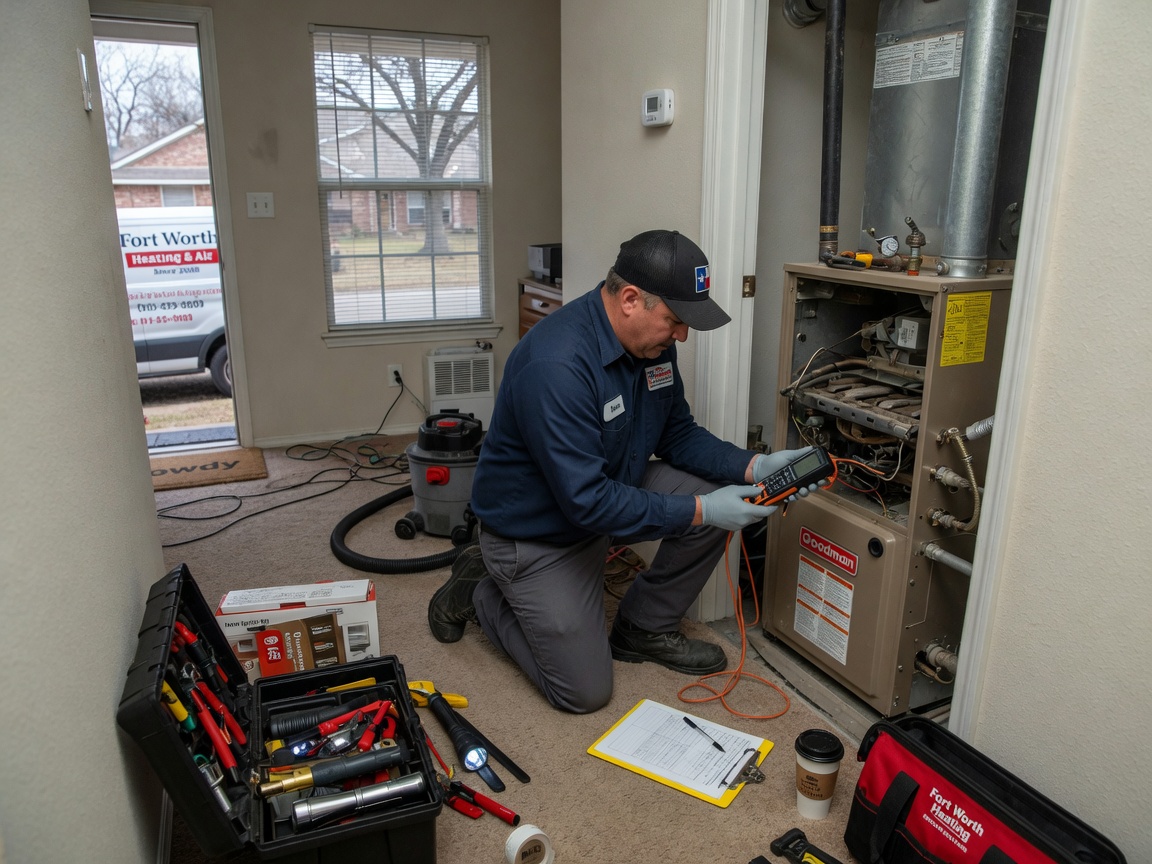
Fort Worth homes built before the 1980s in Arlington Heights and near the Stockyards often have original ductwork and single-stage furnaces that struggle during the rare winter drops below freezing. These systems sit in attics or crawl spaces where humidity from the subtropical climate can corrode heat exchangers over time. Technicians check for cracked exchangers and improper venting that can send combustion gases into living spaces, especially in two-story homes around TCU Stadium where airflow is restricted by tight insulation retrofits.
Service calls in neighborhoods like the Cultural District and Downtown frequently involve heat pumps that were sized for hot summers but short-cycle when temperatures swing quickly in January. Technicians verify defrost cycles and auxiliary heat strips because many units installed in the 1990s lack proper sensors for Tarrant County’s variable winter loads. Homes near Keller and Mansfield roads also see more wear on blower motors from the fine dust that blows in from surrounding open land.
Upfront inspection includes checking gas line pressure at the meter, measuring temperature rise across the heat exchanger, and testing condensate drains that clog from pollen and humidity. Older homes in the Stockyards area often have undersized returns that create negative pressure and pull in unconditioned air from crawl spaces. Addressing these details prevents short cycling and keeps utility bills stable during the short heating season.
Technician insight
In Fort Worth the thing that catches most people out with heating service is how homes in Arlington Heights and the Stockyards still run original metal ductwork that was never sealed for today’s tighter envelopes, so cold air leaks in the moment a winter front arrives and the furnace short-cycles trying to keep up.
TCU Area Heat Pump Short Cycling
A 1980s home near TCU Stadium lost heat during a January cold snap. Inspection found a failing defrost sensor and unsealed return ducts pulling attic air. The sensor was replaced, returns were sealed, and the system maintained steady output without auxiliary heat kicking on every cycle.
Heating Service Services We Offer
✓Furnace Repair in Fort Worth
Diagnose and fix ignition failures, limit switch issues, and blower motor problems common in older single-stage units found in Arlington Heights homes.
✓Heat Pump Repair
Restore reversing valve function and defrost sensor accuracy so systems handle Fort Worth’s quick temperature swings without relying on expensive auxiliary heat.
✓Gas Furnace Tune-Up
Clean burners, test combustion, and calibrate thermostats to maintain safe operation through mild winters in Tarrant County neighborhoods.
✓Heating System Installation
Replace outdated furnaces and heat pumps with properly sized equipment matched to the insulation levels in Downtown and Cultural District homes.
✓Ductwork Repair and Sealing
Fix leaks and add insulation to ducts in attics and crawl spaces that lose heat in older Stockyards and TCU area properties.
Heating Service Cost in Fort Worth, TX
| Service | Typical Range | What Affects It |
|---|---|---|
| Furnace Tune-Up | $150–$300 | Higher when attic access is limited in two-story homes near TCU |
| Heat Pump Diagnostic | $100–$200 | Includes defrost and auxiliary heat testing |
| Duct Sealing | $400–$900 | Depends on linear feet and attic insulation depth |
| Ignition or Limit Switch Replacement | $250–$550 | Parts and labor for common 1990s–2000s furnaces |
Ranges are typical for Fort Worth, TX and confirmed with an exact written quote before any work starts.
How it works
- 1
Initial Assessment
Arrive on site and review system age, recent performance issues, and home layout in the specific Fort Worth neighborhood.
- 2
Diagnostic Testing
Measure temperature rise, static pressure, and gas pressure while checking for carbon monoxide and venting problems.
- 3
Repair or Adjustment
Replace failed components, seal ducts, or recalibrate controls using parts suited to local humidity and dust conditions.
- 4
Final Verification
Run the system through a full cycle and confirm safe operation before leaving the home.
Pricing
Upfront quotes provided after inspection; pricing varies by system age and access in older Fort Worth homes.