Fort Worth's humid subtropical climate drives heavy latent loads on any new system, especially during long stretches above 95 degrees when humidity lingers after sunset. Homes in Arlington Heights and the Cultural District often retain original 1950s–1970s ductwork that leaks in unconditioned attics, so proper load calculation must account for those losses before equipment is selected. Oversized units short-cycle, fail to dehumidify, and push higher utility bills in Tarrant County summers.
Soil movement common in parts of Mansfield and Keller can shift slab foundations and alter return-air pathways over time, requiring installers to verify plenum seals and add flexible connections. In Downtown and Sundance Square condos, limited mechanical space often forces high-efficiency, low-profile equipment with condensate pumps that handle the region's frequent afternoon storms without overflow. Proper refrigerant line insulation prevents sweating that stains ceilings in older TCU-area bungalows.
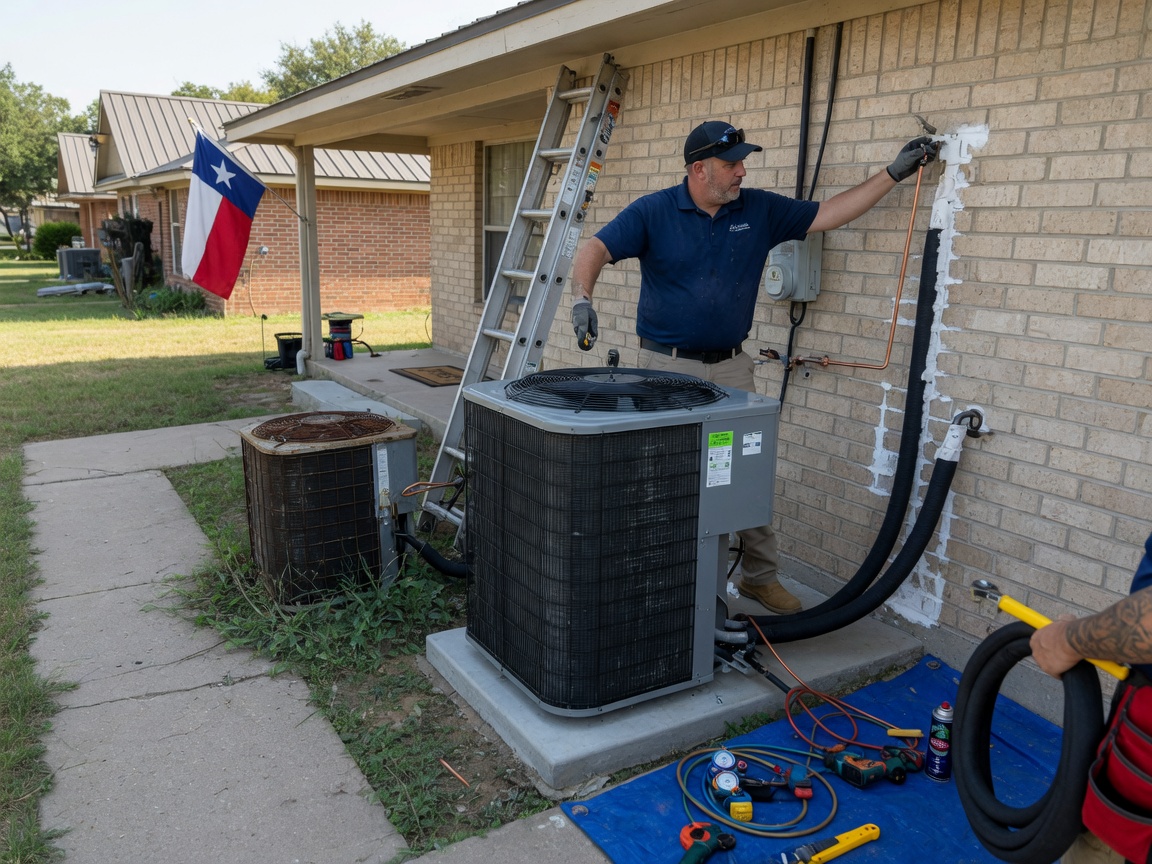
We pull permits through the City of Fort Worth and coordinate with local inspectors on electrical upgrades required for modern SEER2 ratings. Installation includes new thermostats matched to the home's zoning and verification that supply runs reach second-floor bedrooms that bake under the summer sun. Final commissioning checks static pressure and temperature split at multiple points to confirm performance before the crew leaves the site.
Technician insight
In Fort Worth the thing that catches most people out with AC Installation is the amount of attic heat gain in 1960s Arlington Heights and TCU homes; if you don't seal and bury the ducts while the system is open, the new unit will short-cycle all summer even when sized correctly.
Cultural District Bungalow Retrofit
The 1962 home had a failing 3-ton unit and leaking flex duct in a 130-degree attic. We performed a room-by-room load calc, replaced the system with a SEER2 17 variable-speed unit, sealed and insulated the main trunks, and added a condensate safety switch. The homeowners reported even temperatures on the second floor and noticeably lower humidity the first week of July.
AC Installation Services We Offer
✓Central AC Installation
Full central system replacement sized for Fort Worth humidity loads and existing ductwork in single-family homes across Arlington Heights and TCU neighborhoods.
✓Ductless Mini Split Installation
Zone-controlled mini-split systems ideal for additions or older Stockyards homes where running new ductwork is impractical.
✓High Efficiency AC Installation
SEER2 16+ units installed with matching coils and variable-speed blowers to cut summer energy use in Tarrant County heat.
✓Attic Duct Sealing During Installation
Mastic sealing and insulation of existing ducts while new equipment is set, reducing leakage common in Cultural District attics.
✓Slab Home AC Installation
Equipment and line-set routing planned around foundation movement typical in Mansfield and Keller properties.
AC Installation Cost in Fort Worth, TX
| Service | Typical Range | What Affects It |
|---|---|---|
| 3-Ton Central AC Installation | $5,200–$7,800 | Includes new coil, lineset, and basic thermostat; rises with SEER2 rating or attic duct sealing. |
| Ductless Mini-Split Installation | $3,800–$6,500 | Per zone; multi-zone systems cost more in Cultural District condos with limited outdoor space. |
| Duct Sealing Add-On | $650–$1,400 | Required on many pre-1980 Arlington Heights homes; priced by linear feet of accessible duct. |
| Electrical Upgrade | $450–$950 | Common when older Stockyards homes lack 60-amp circuits for modern units. |
Ranges are typical for Fort Worth, TX and confirmed with an exact written quote before any work starts.
How it works
- 1
Site Assessment
Measure every room, inspect existing ducts, and calculate Manual J load using local design temperatures for Fort Worth summers.
- 2
Equipment Selection
Match tonnage, SEER rating, and airflow to the home's construction and orientation while staying within City of Fort Worth permit rules.
- 3
Installation Day
Remove old unit, set new equipment on level pads, run new linesets with proper insulation, and seal all penetrations against attic heat.
- 4
Commissioning and Handover
Verify static pressure, temperature split, and condensate drainage, then program the thermostat and review maintenance steps with the homeowner.
Pricing
Upfront written quotes after on-site assessment; final price depends on tonnage, efficiency rating, and duct modifications required.