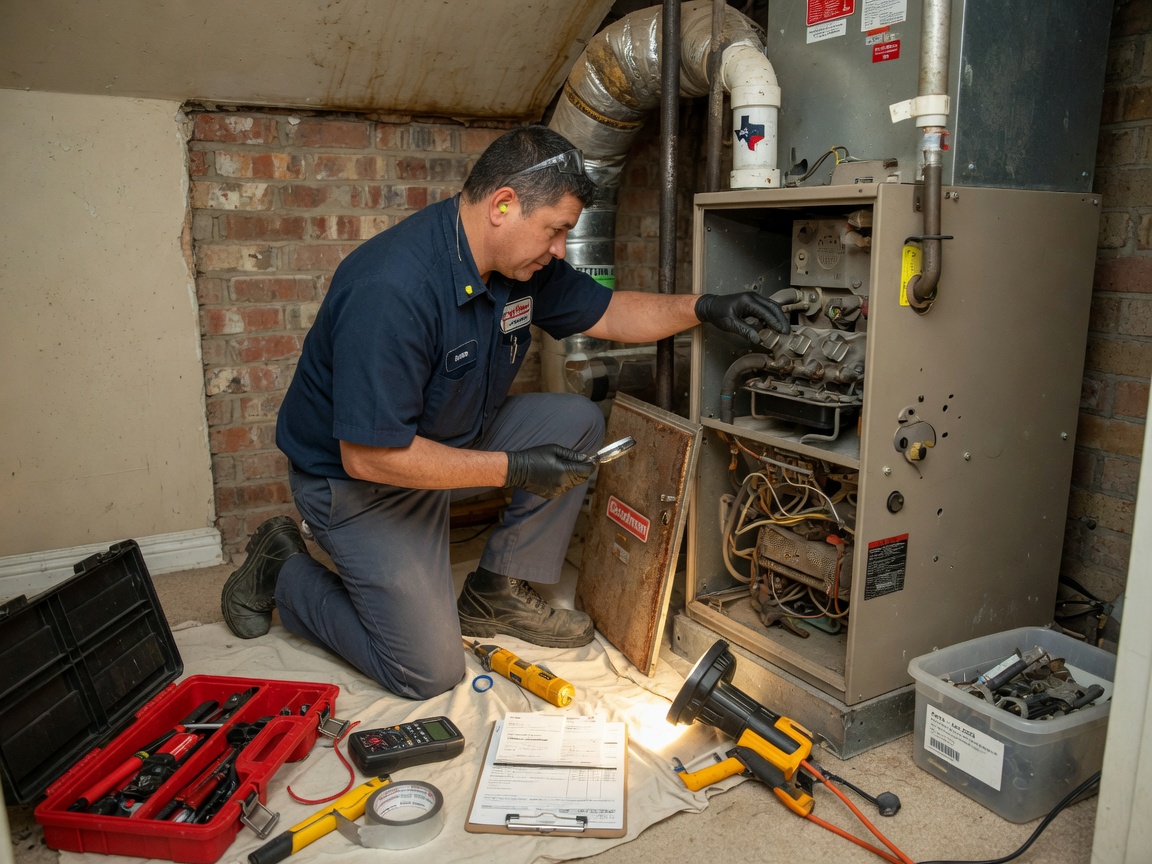
Fort Worth's humid subtropical climate brings mild winters that often leave heating systems idle for months, allowing dust and corrosion to build up in older homes found in Arlington Heights and the Cultural District. When temperatures finally drop, these neglected units in Tarrant County neighborhoods frequently fail on the first cold snap, especially in stock built before the 1980s with original ductwork that has settled unevenly over time. Technicians here routinely deal with cracked heat exchangers in gas furnaces and failing blower motors strained by years of attic dust common near the Stockyards and TCU area.
Repair calls in Downtown and Sundance Square often involve compact installations in historic buildings where access is tight and code updates require specific venting adjustments not needed in newer Mansfield or Keller subdivisions. Local soil movement from the clay-heavy Tarrant terrain can shift foundations slightly, pinching return ducts and reducing airflow to units that already struggle during rare hard freezes. Experienced crews check for these hidden issues rather than simply swapping parts, because replacing a control board without addressing the underlying airflow problem leads to repeat failures within weeks.
Homeowners in TCU and Arlington Heights sometimes attempt DIY thermostat swaps only to discover incompatible wiring left from previous conversions from oil to gas systems, a common upgrade path in the county. Proper diagnosis includes verifying gas pressure at the meter and inspecting flue termination heights that can be blocked by nearby construction or mature trees typical in established neighborhoods. These steps prevent carbon monoxide risks that rise when mild weather suddenly turns and systems run continuously for the first time all season.
Technician insight
In Fort Worth the thing that catches most people out with heating repair is how mild winters let dust settle in ducts and on heat exchangers for eight months straight, especially in the older brick homes around Arlington Heights and the Stockyards where original returns were never oversized for today's filters.
No-Heat Call in Arlington Heights
A 1970s home near the Cultural District lost heat on the first freeze of the season. Inspection showed a failed igniter plus restricted return air from settled ductwork under the crawlspace. The crew replaced the igniter, sealed two separations, and restored full airflow so the furnace ran cleanly through the cold snap.
Heating Repair Services We Offer
✓Furnace Ignition Repairs
Diagnose and replace faulty hot surface igniters or spark modules that fail after sitting idle through Fort Worth's mild winters.
✓Heat Pump Reversing Valve Service
Repair or replace stuck reversing valves in heat pumps common in Arlington and Keller homes that struggle switching between heating and cooling modes.
✓Blower Motor Replacement
Install new blower motors in systems affected by attic dust accumulation prevalent near the Stockyards and Cultural District.
✓Thermostat Wiring Diagnostics
Trace and correct wiring issues left from older conversions in Downtown and Arlington Heights homes to restore reliable heating calls.
✓Ductwork Airflow Restoration
Locate and repair pinched or separated ducts caused by local soil movement in Tarrant County neighborhoods like TCU and Mansfield.
Heating Repair Cost in Fort Worth, TX
| Service | Typical Range | What Affects It |
|---|---|---|
| Diagnostic Visit | $89–$129 | Waived if repair is completed same visit |
| Igniter or Flame Sensor Replacement | $180–$320 | Parts and labor; varies by furnace brand and age |
| Blower Motor Replacement | $350–$650 | Higher in tight attic installs common in Arlington Heights |
| Thermostat and Wiring Repair | $150–$280 | Includes tracing older wiring in pre-1980 homes |
Ranges are typical for Fort Worth, TX and confirmed with an exact written quote before any work starts.
How it works
- 1
Initial System Assessment
Technician arrives within the service window and checks thermostat settings, airflow, and gas supply before running the unit through a full cycle.
- 2
Component Testing
Ignition system, blower motor, and safety switches are tested with multimeter readings to isolate the exact failure point.
- 3
Targeted Repair
Faulty parts are replaced using manufacturer-approved components while addressing any related issues like restricted vents found during inspection.
- 4
Final Performance Check
System is run through multiple cycles, temperatures are verified at multiple registers, and the homeowner receives a written summary of findings.
Pricing
Most heating repair visits fall into a diagnostic-plus-repair range; final cost depends on parts needed and access conditions in older Fort Worth homes.